


Now that I’ve written a bunch of these “almost daily ROAR” posts to our wider audience, I’m going to tilt things a bit. How?
Shorter posts (after today) simply focused on what I see, and why. And behind the paywall.
Of course, the ROAR Score system we built at ROAR.PiTrade.com, which is free to try for now, is the research “lab” from which all of these posts originate.
We are moving most of my daily posts behind the paywall for a simple reason. We think it is valuable. Because it is based on 40+ years of experience. And because in a market where risk management is suddenly queen, king, princess and prince, our approach is more valuable than ever. So our paid subscribers should get as much exclusivity as possible.
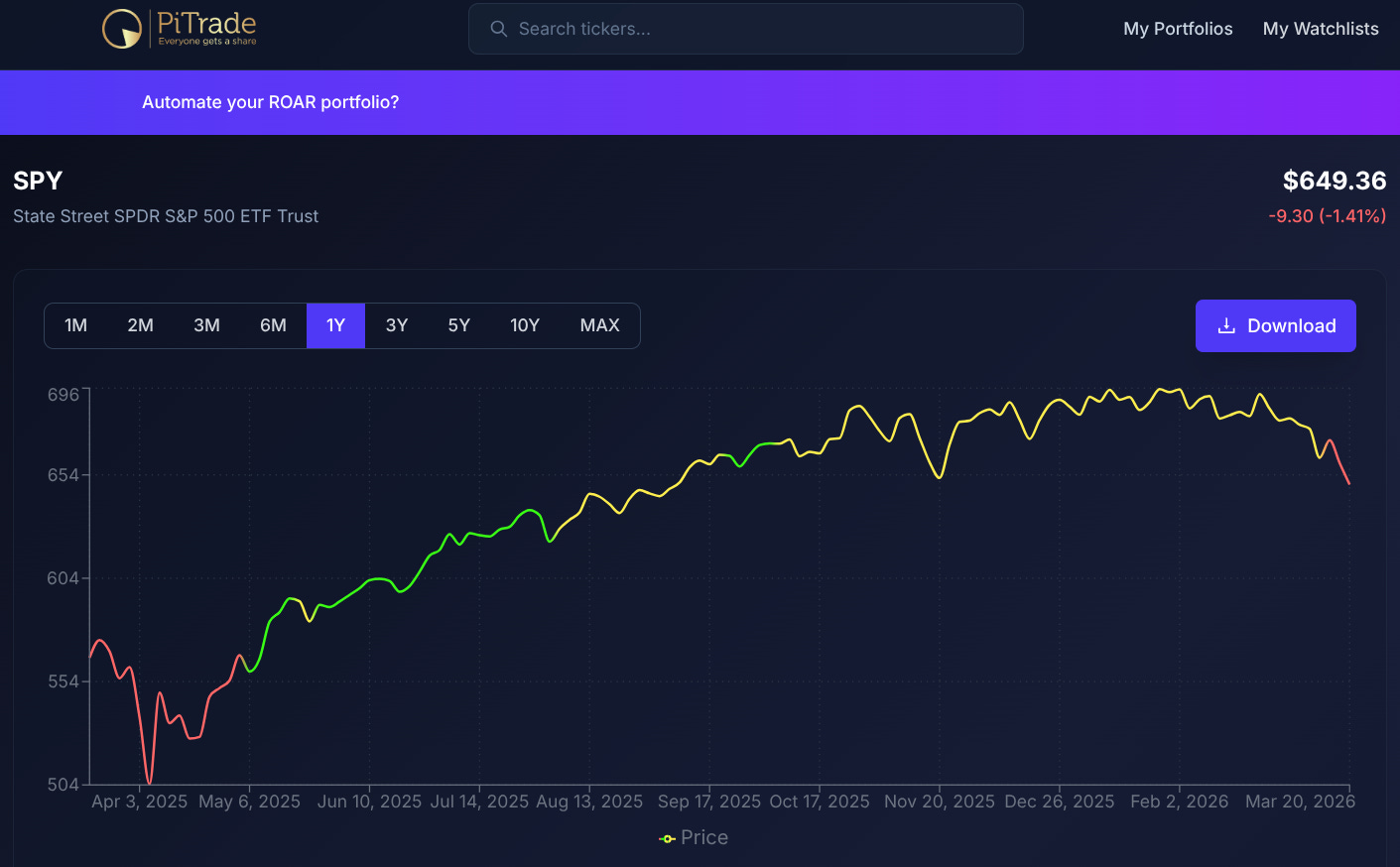
The S&P 500 (SPY) ROAR Score has been as good a guide the past 12 months as it can be. There to warn of a pending slide at this time last year (far left side of chart), cautious through the first “fakeout” bounce, then a rare red to green (high risk to low risk) signal in a week (charts like this one below show ROAR Score risk levels on a weekly basis, not daily, to cut some of the daily “noise” in the stats).
Then, a prolonged period in the yellow (neutral risk) zone, before finally indicating elevated risk (red - far right side) just as things were about to go from bad to worse.
That’s past tense. Now, let’s move on to the current market. Because while many strategists spend times like this trying to play their own personal game of “Twister” to make the case that all will be well…I don’t assume any of that. Nor do I guess.
I rely on a decades-long approach to investing that simply says, “any ETF or stock can go up at any time…so it is measuring risk of major loss at ALL stages of the cycle that, in my experience, creates a more comfortable path to long-term investing success.
I’ve written enough general posts about that system so that along with the Quick Start guide on that analysis site, as well as the START tab here at ETF yourself.com, we hope we have put plenty of intelligence in your hands. Now that we have, let us know what you think, and how we can make both of these research services better!
Now to today’s topic. The 2 ETFs I am watching that could be the unsung heroes of this market. And I doubt you have heard of them, unless you’re an ETF wonk like me.
The first is Direxion Daily 20-Year Treasury Bear 3X (TMV). You are familiar with TBF since it is one of 10 ETFs my ROAR 10 portfolio. TBF uses a modest amount of leverage to short the bond market. That is, if rates go up, TBF does too. That’s helpful since that’s also when long-term bond prices go down. So it’s a useful hedge if you own bonds (like I do, where my bond ladder is my biggest account). Or it can simply be a way to try to profit from higher rates.
TMV has $160mm in assets, and it has been around since 2009. But that pales in comparison to TLT, which owns 20-30 year Treasury bonds. That ETF has more than $45 billion in assets! And it has not made money in a while, as rates have come up off the floor since 2022. As they say, there’s no accounting for taste!
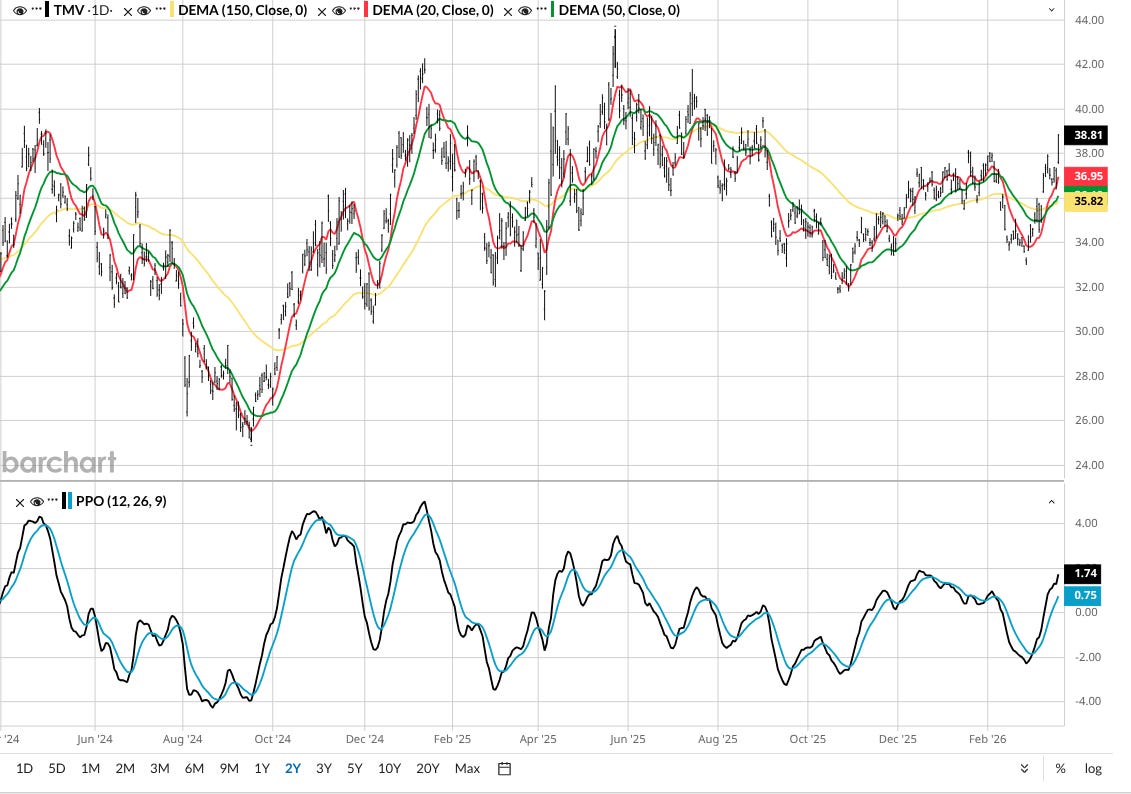
TMV is not for everyone for sure. It is 3x leveraged. So if rates continue to rise it will continue to spike higher. Of course, the reverse is true as well. A sudden flight to quality rally in bonds will sink this fast. That’s why to me, these leveraged ETFs are very useful tools, but ONLY when used responsibly.
What does that mean? With the rest of the portfolio’s positioning considered. Just speculating on these is fun and games with very small amounts of capital. But to me, they are alternatives to owning put options on TLT. Be careful out there.
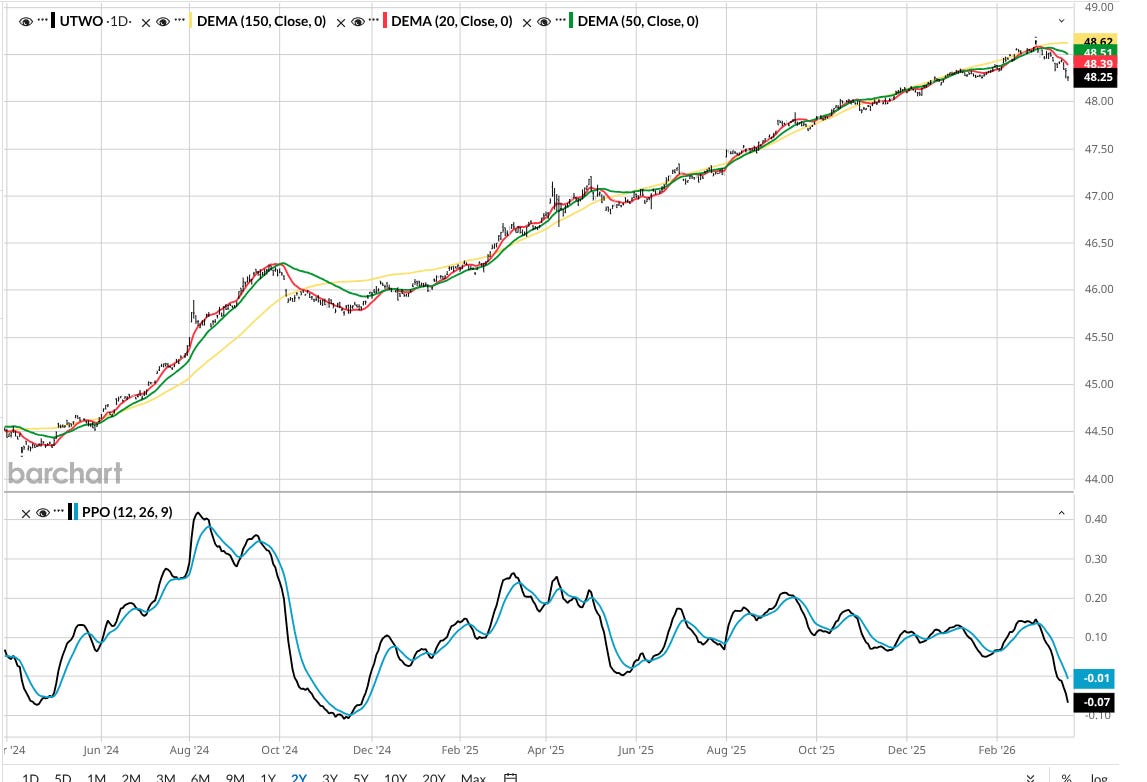
The other one is US Treasury 2 Year Note ETF (UTWO). I present this one in large part because I’m closely monitoring 2-year Treasury rates. Not so much to own this ETF, but because I’m starting to see a real possibility that for those who do not use inverse or volatility ETFs or put options in their portfolio, this might end up being a top performer over the next 24 months. I’ve seen it many times before.
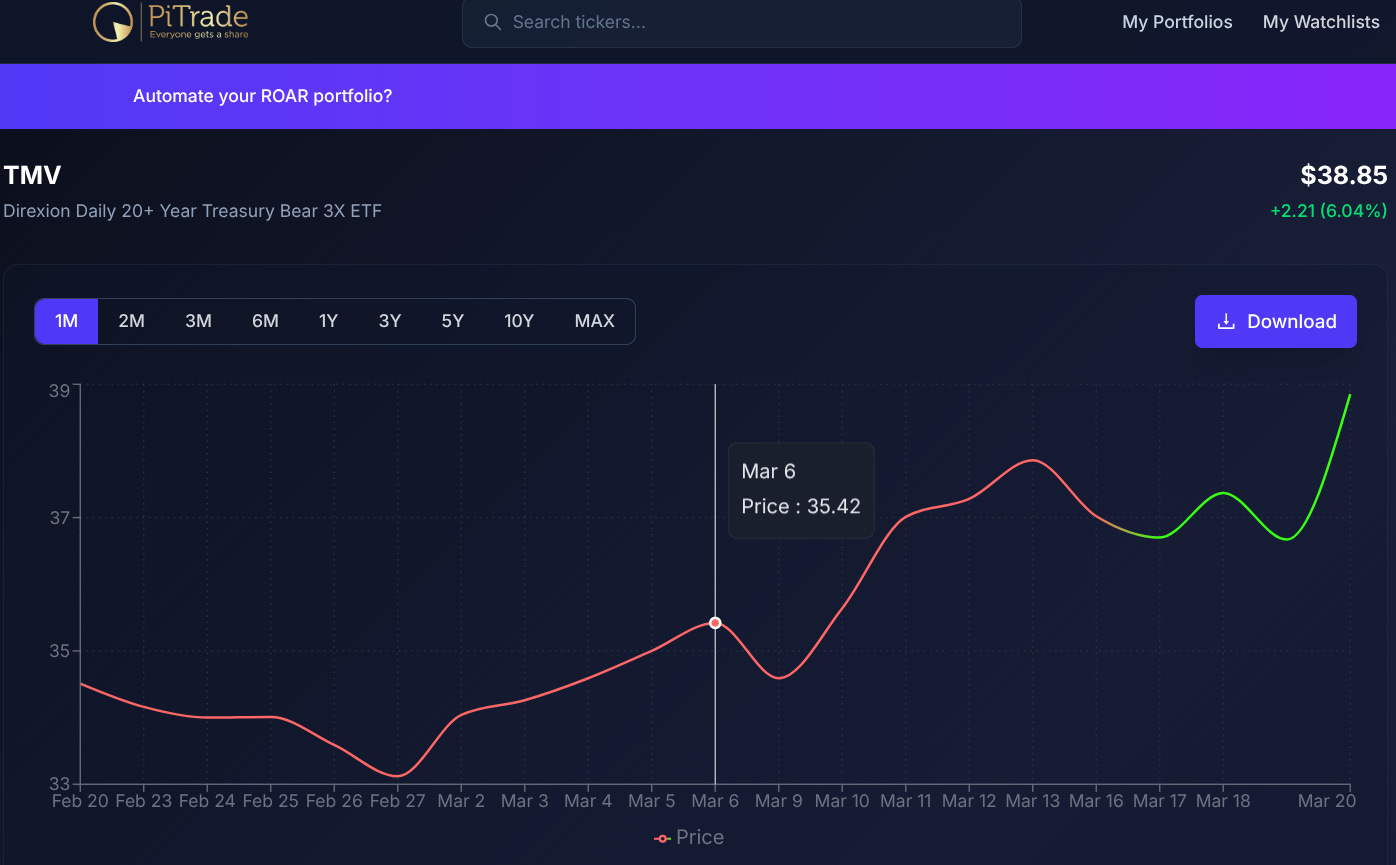
And here is the ROAR analysis for TMV.
If you own the ETF, you do not own the bonds themselves. So you will have some very modest price fluctuation that does not resolve at maturity. Because there is no maturity date.
The reason I’m carefully tracking 2-year yields as they approach 4% is not only because, as in 2022, if stocks and bonds fall together, 4% return looks pretty darn nice. But also because as a fan of zero-coupon Treasuries, which are purchased at a discount and mature at par ($100).
The Math
A 4% return over 2 year is about 8.2% compounded. That means for $92 invested today, I can get $100 returned to me in 2 years, period. And while that is not the best return I’ll ever get, it serves as a BASE from which I can be more aggressive.
One example: if I take $100, invest $92, and use the other $8 to invest more aggressively than I otherwise might with the whole $100, my worst case scenario in 2 years? I get my $100 back. I’d have to speculate with options and lose it all for that to occur.
Let’s say I turn that $8 into $12 in 2 years, free to do things I would not do normally, in a market that might just reward that. $12 there, plus $100 back from the $92 in the 2-year bonds. Thats’ $112, or about a 6% annualized return. With a 0% return downside.
That’s just a basic example. But its a good example of risk management at work. And using the markets as a tool, learning those tools, to play offense AND defense at the same time.
I welcome your questions, comments and feedback!