

Thanks to those who have taken us up on our offer to upgrade their subscriptions from our Premium tier to the new Flex Model Signal tier. Since we have been fielding lots of emailed questions aimed at distinguishing between our service levels, I’ll present this and summarize:
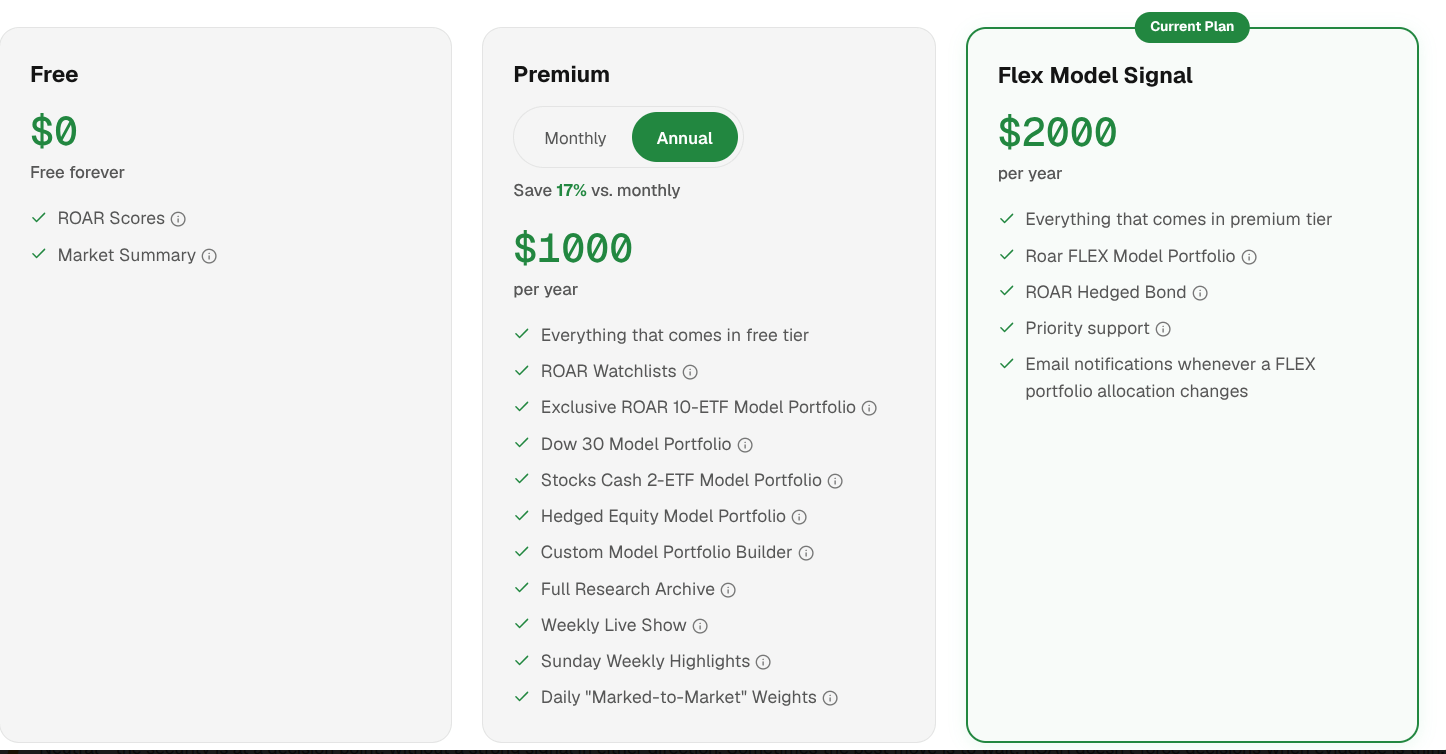
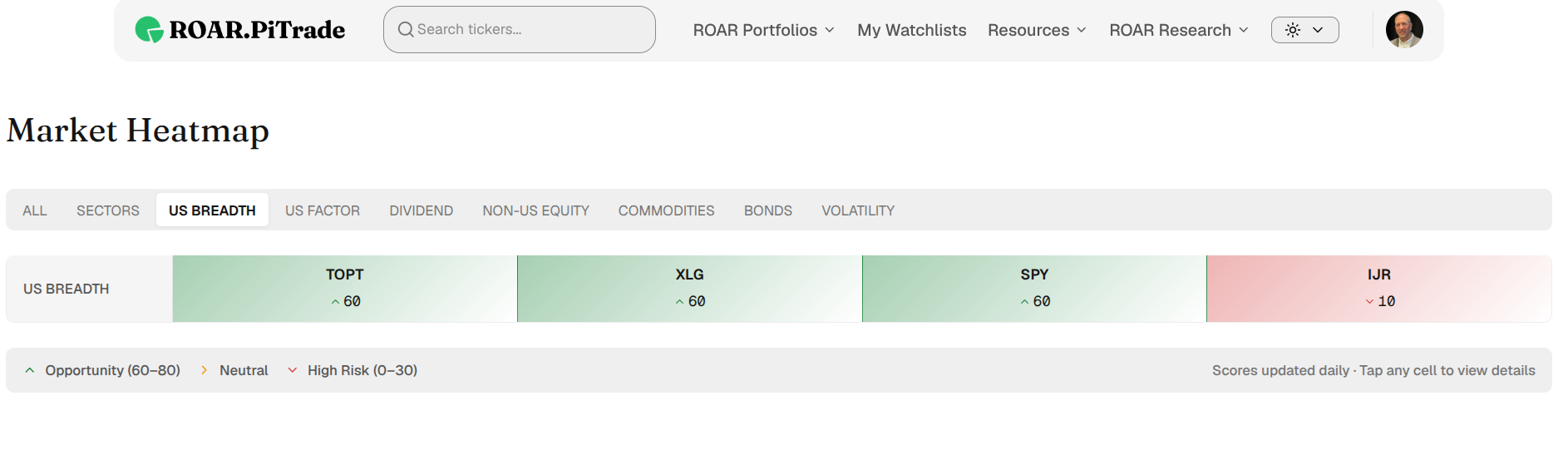
For $0 a year (a.k.a. free), you can see the top/intro section to my Tuesday Weekly ROAR, as you are doing as you read this. And, you can create a free account at ROAR.PiTrade.com and pull up my daily automated market summary. Here’s one clickable section of it, that indicates to me that as of Monday’s close, the big stocks are again better-positioned from a return/risk tradeoff standpoint then the smaller ones.
We track the global markets through dozens of ETFs. And you can also pull up current ROAR Scores on any ETF or stock. All free. You just need to registered with your email. You don’t even need to be an ETF yourself.com ($200/year) paid subscriber to access it.
The other 2 levels are the paid subscriptions. They both contain access to all of my automated model portfolios, plus the ability to create and track your own. And, more extensive access to the research data in that portal. You can also use the portal as an access point for all you see here at ETFYourself.com, as well as the roughly 400 articles I’ll write at Barchart.com this year.
I know I’m biased, but I’ve yet to see a DIY portfolio creation system that can match what we built. And we priced it so that any investor with at least $100,000 in “serious’“ investable assets could afford it.
If you are a total DIY investor, and do not care about knowing what I trade in my personal (live, not automated) model portfolios, as soon as I trade, the Premium service tier is for you.
And if you DO care to know what I’m trading in those personal models, either to mimic my trades in your brokerage accounts, or just to use it as research input and to learn how an experienced investment allocator (me) works, that’s who the new Flex Model Signal tier is designed for.
To subscribe to any of the 3 service levels shown above, visit ROAR.PiTrade.com.
Model Portfolio Updates
In fairness to the paid subscribers to the new Flex Model Signal service tier, my discussions of specific trades in those live portfolios (ROAR Flex and Hedged Bond) here will be very limited. What I will do regularly is bottom-line my positioning, in words, less so than numbers. And, since those 2 portfolios recently kicked off, and are actively managed, I figure this is a good time to summarize how I “set the table” at the outset of each.
For paid Flex Model Signal subscribers, we have now installed the trade notes feature. So embedded with most model changes will be a very brief commentary on those trades. As for regular portfolio position and past transaction updates, that’s all on the way soon. We are just determining the most efficient way to deliver it, to avoid you chasing lots of emails and such.
ROAR FLEX INITIAL POSITIONING
I have ROAR 10, all present and accounted for. Except for VIXY, which I have left out for now.
$VIX is not acting normally, and hasn’t been for a while. And ROAR Flex allows me to expand beyond those 10 core ETFs, which includes inverse ETFs that essentially short parts of the stock market, sectors, or even some single stocks. With and without leverage, depending on the underlying security. I’ve helped myself to some small positions in those.
“Small” as in, even if they go down a lot, I don’t have enough in them to have too much of an impact on the larger portfolio. Why bother? Because a small position can become a big one in some cases. And I can add to them if I the “early buy” status I assigned to it to take, say a 1-2% portfolio position, appears to be doing what I expected it to.
Most of these have been on the inverse side so far. If Monday’s head-spinning, AI-focused rally has any “legs” to it, that might prompt my attempting to “take a big shot with a small amount of the portfolio” on some of the high-flyers.
As of Monday close, there were no single stock positions. That’s not due to a lack of effort on my part. But it does speak to how few “clean setups” are available. I buy stocks when an ETF won’t suffice. And when the market is just one big risk on/risk of trade surrounding the potential of a new tech era that companies are spending historic amounts of money on, creating a race to see if that spending pays off…well, that’s not a stock-picking environment to me.
Overall, this portfolio is about playing offense and defense at the same time. That means I’ll always have longs and inverses. But the overall “net long” posture is what I focus on more than anything else.
That does not lend itself to traditional portfolio allocation lingo as much as what you’ll see just about everywhere else, except for some long-short hedge funds. So I’ll be less likely to describe sector and geographical allocations, as those tend to be isolated to the tactical (“swing trading”) parts of the portfolio.
HEDGED BOND INITIAL POSITIONING
The initial ladder of IShares IBond ETFs is now established. I took equal-weighted positions in each. Since this is my portfolio, and every DIY tends to be different when it comes to the specifics of their own ladder within a larger bond portfolio, the best way to get insight into the infinite ways to customize your own bond ETF mix is to attend our weekly live sessions. That’s open Q&A time.
The supplementary positions include some that aim to add return if rates decline, and others if they continue to rise. Do both cancel each other out? No.
There are 2 reasons for this. First, I am not sitting still on these. The ladder is the anchor, these are the tactical trades around that ladder. As I see it, if I were 100% confident that rates would never be this high again for decades, I’d just get that 5% yield and when rates fell, I’d make more. But nothing is guaranteed.
So instead, I know that a strong segment of the Hedged Bond portfolio is my base, and yielding close to 5%. And like a ladder of actual bonds, those ETFs mature annually, so they act a lot like owning bonds.
Rates are as unpredictable as ever now. That’s why the time to create and offer Hedged Bond as a way to learn from what I DO, not just what I SAY OR WRITE, was so timely in our minds. And those of several subscribers.
So the other portfolio positions have different roles for different parts of the yield curve. I might not need 8 additional ETFs beyond that ladder as I started the live model with. But if there’s one thing the ETF business excels at, it is giving us choices. That’s a good start. I’ve spend decades understanding how to use those choices tactically. So I prefer to use several of those tools here at the outset.
As time goes on, as I always do, EVERYTHING in the portfolio is evaluated regularly. Those laddered ETF positions will always be there. But they might not always be allocated at the same allocations they are now. It depends on what I think I want to have come due each year to spend and/or reinvest. That’s why this portfolio works so well via model signal delivery.
To subscribe to any of the 3 service levels shown above, visit ROAR.PiTrade.com.