


For a while now, I’ve been reviewing in articles and live sessions what is perhaps the unsung hero of my own family’s financial future. My “bond ladder.” That’s where you buy bonds that mature annually, and either take the money and spend it (as I anticipate doing starting later this decade or early next decade), or roll it back into the ladder to add another year (“rung”) to it.
If this has a nice ring to it, it might be because you realize like I do that while bond rates are treated by much of the financial press these days as an inconvenient cousin to the stock market, some of us think that what’s happened since the start of 2022 is fanstastic for the currently-retired and semi-retired among us.
What happened? This is what happened.
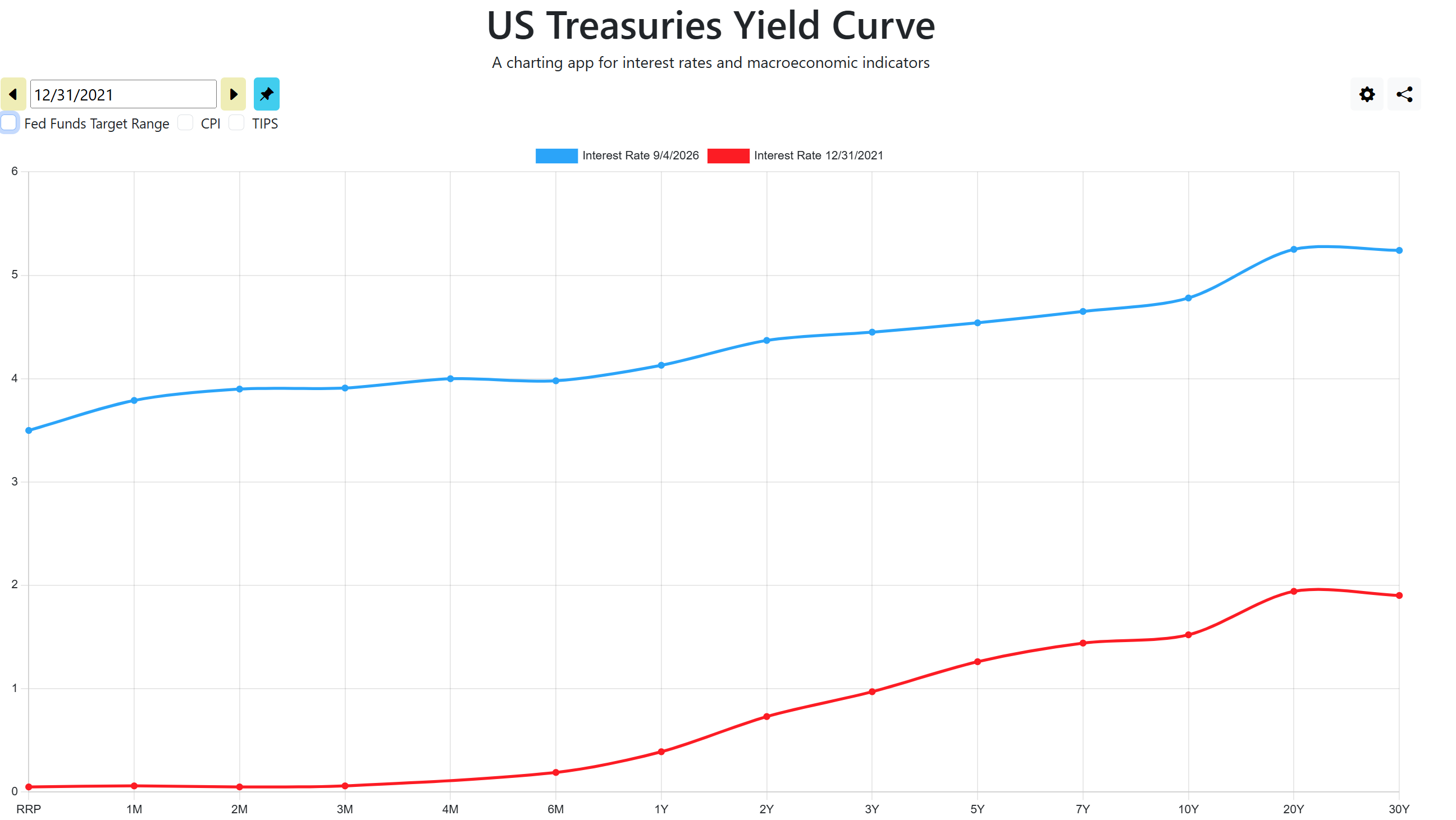
Interest rates on US Treasury securities rose from the ashes of the previous decade, and restored themselves to what I consider to be a compelling long-term return level.
4.5% for 3 years? 4.8% for 10 years? 5.2% for 20 years? That isn’t anywhere near what stocks have done. And as rates have risen so much the past 5 years, and rising rates cause bond prices to fall, bond returns have, to use a techincal term…sucked.
Which is where the contrarian investor who’s semi-retired and remembers how great a bond portfolio used to be as a complement to those long-term growth investments (stocks) says “hey, why not create a little bond ladder?? Well, one thing led to another, and it turned out, my audiences here and elsewhere kept asking questions about it.
So recently, I posed the question:
If I could, in ETFYourself.com style, create a bond ladder model portfolio that skipped the part where one buys the bonds individually, would you care?
And, if I went a step further, and added “wings” to the portfolio in the form tactical ETF positions that could allow that ladder to “sit there doing it’s thing,” while I traded those other ETFs around it to hedge higher rates and add return when rates fall over time, would you care even more?
A pair of YES responses later from enough of our subscribers, and Hedged Bond model portfolio was born. This past Tuesday, I built and traded the model on PiTrade.com with my own money. And I am in the process of shifting some of my current ladder of individual bonds to the Hedged Bond model.
It is available to investors (and financial advisors) in 2 forms:
As a portfolio where my trades are communicated to you when they happen, just as with our new ROAR Flex allocation model and others at our research site, ROAR.PiTrade.com. To make it easier for more people to say YES, we have combined it into a single, Model Signal subscription level. Visit ROAR.PiTrade.com for details.
As a portfolio overseen and traded by PiTrade.com, a Registered Investment Advisor (RIA). You can get the details on that version of the Hedged Bond model there.
As you can imagine, I’m not usually in the business of showing my current portfolio to just anyone. That’s what the Model Signal service is about. Back in the days we ran an investment advisory firm, the typical client paid $20,000-$40,000 a year for a full service that included my ability to develop and manage model portfolios. Now, DIY investors and advisors can access my “best thinking” for a small fraction of that price.
I realize that many investors are new to bond portfolio investing. When rates are too low to matter and the stock market is vaulting higher most years, why bother? I think that’s changing, quickly.
Below, I present here the initial Top 10 positions I bought this week. Some will likely remain for a while, and others are “live every day,” which means I could adjust their portfolio weightings, remove them altogether, or add new ones.
You’ll also find a quick comparison of the initial Hedged Bond model portfolio to the Vanguard Total Bond Market ETF. Which by the way, does not manage tactically, and certainly does not hedge versus rising rates. It is a bond index. Which as nice as that sounds, is not at all the same thing as a stock index such as the S&P 500.
So today’s snapshot doesn’t really indicate what this portfolio might look like a week or a month from now. But it does provide a starting point for investors who want to peek a bit behind the curtain.