

By Rob Isbitts

Let’s be honest: Wall Street loves to make investing sound like rocket science. They’ll sell you a 30-fund “diversified” portfolio that ends up being nothing more than a giant, expensive closet index. Over my 30-plus years as an advisor and fund manager, I’ve learned that complexity is often the enemy of clarity—and the enemy of your returns.
That’s why I developed my 10-ETF Model Portfolio. It isn’t just a list of tickers; it’s a philosophy. It’s built on the idea that you don’t need 500 stocks to win; you need 10 focused “buckets” that allow you to play offense when the sun is shining and a rock-solid defense when the clouds roll in.
The Architecture: 10 Slots, One Mission (a Core Portfolio)
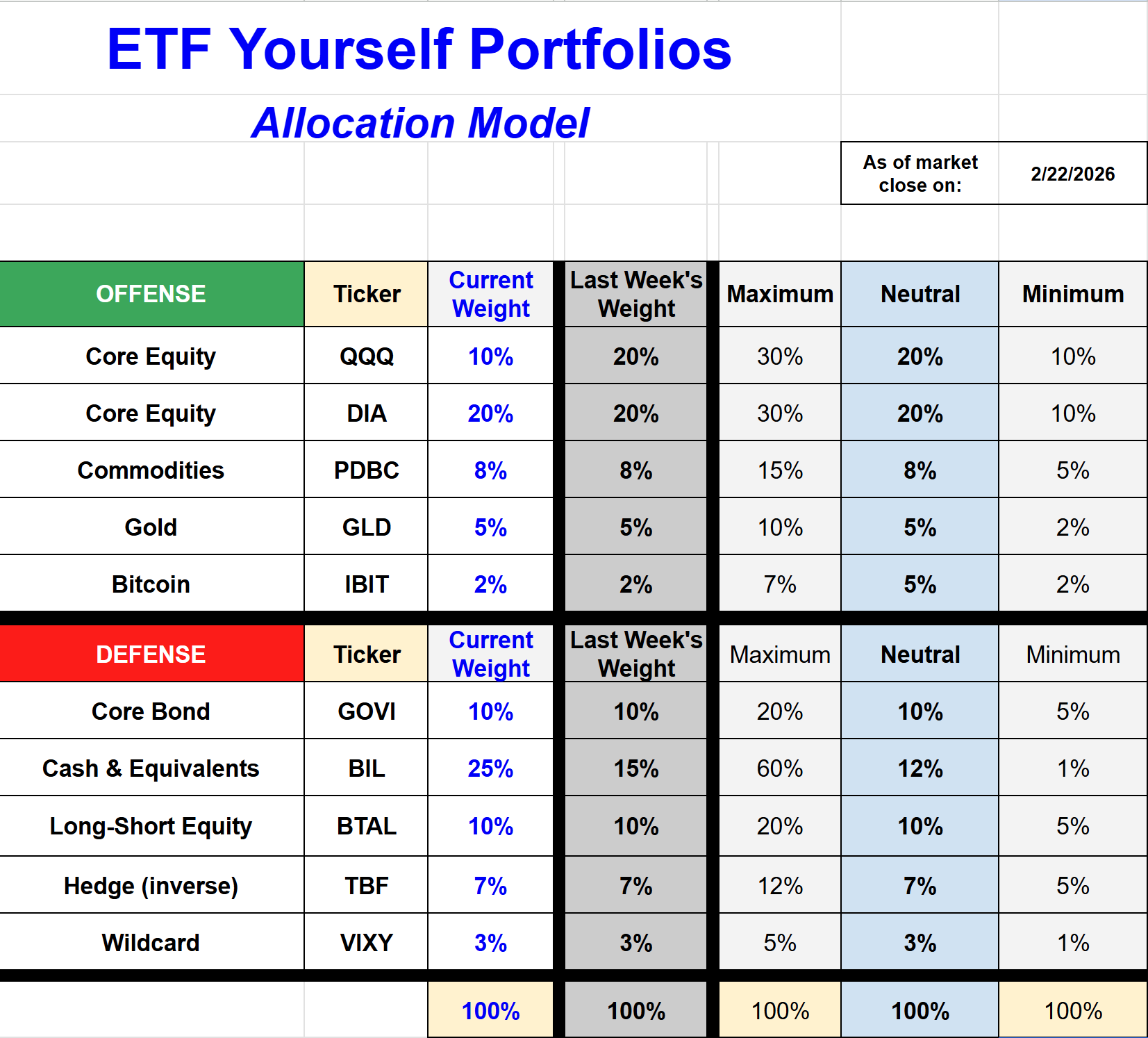
Here’s what this portfolio looks like when I include and update and commentary on it every Tuesday in our Weekly ROAR newsletter for paid subscribers. This portfolio is also available as part of our “Copy-Trading” agreement with our friends at PiTrade.com. More on that below.
The 10 portfolios slots are always used. That is, I always have at least a token allocation to all 10. This makes it like a more flexible version of the popular “permanent portfolio” approach. Except that here, every week the weightings of each of the 10 ETFs is up for review, based on their ROAR Scores.
As market cycles evolve, I may find it helpful to “upgrade” one or more of the slots. Return and Risk characteristics of different markets change over time, and I’ve seen too many mistakes by investors clinging to things like “income stocks” or “value” or “small caps,” when in fact those market segments can be uncompetitive for a decade or longer. So I remain flexible at all times. I think that’s what helped get me this far (I started managing money professionally in 1993).
This model portfolio is designed to be a “core” investment vehicle. I use it alongside a “bond ladder,” my 2-ETF portfolios, and some short-term trading. That’s my total portfolio.
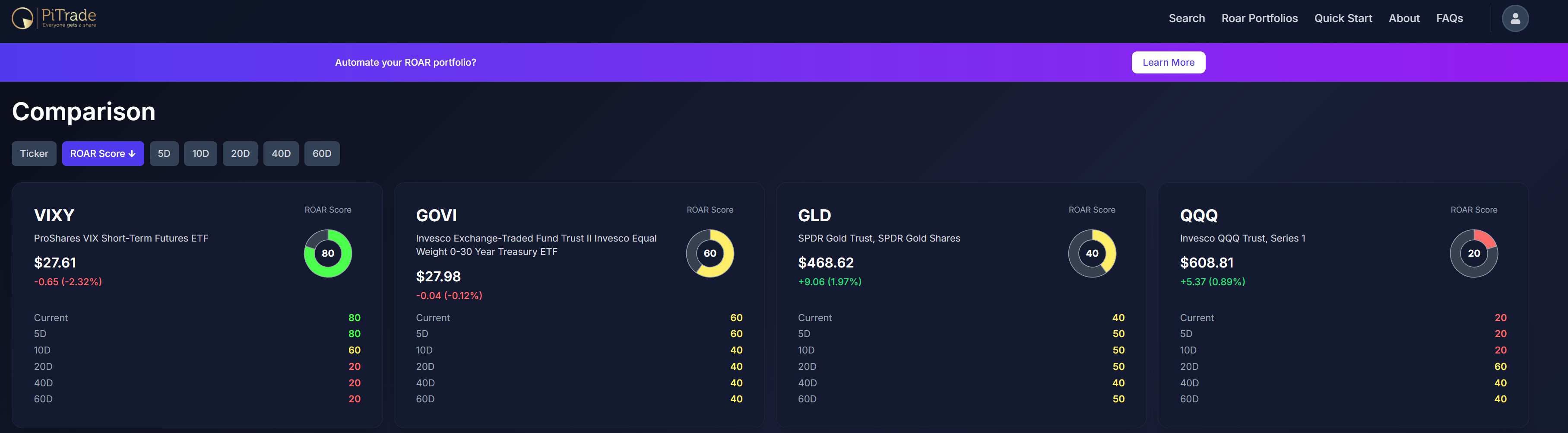
I use 10 specific ETFs to cover the waterfront, but I don’t just “buy and hold” them forever. I manage them tactically using what I call the ROAR (Reward Opportunity And Risk) Score. That’s the name I gave to the systematic approach to analyzing ETF and stock charts, which is now a process whose bottom-line can be seen for any security at any time, at our analytics site, ROAR.PiTrade.com.
Here is how the 10-ETF framework is structured:
Based on the allocation model as of February 22, 2026, here is a simple breakdown of the roles for each of the 10 ETFs, categorized by their mission on the field.
The Offense Squad (Growth & Inflation Protection)
These five positions are designed to capture market upside and protect against the erosion of purchasing power.
QQQ (Core Equity): This tracks the Nasdaq 100, serving as a high-growth engine focused on technology innovators.
DIA (Core Equity): This tracks the Dow Jones Industrial Average, providing a concentrated anchor of 30 blue-chip stocks that are easy to monitor.
My research has concluded that QQQ + DIA + ROAR Score = a better return/risk tradeoff than the S&P 500 (SPY). As long as I believe that to be the case, I’ll keep these two paired within the portfolio, allocating among them.
PDBC (Commodities): An inflation-fighter that invests in a broad basket of commodities like energy, gold, and agriculture.
GLD (Gold): While commodities include some gold, this slot isolates the metal as a dedicated inflation fighter and offset to long-term concerns about fiat currencies.
IBIT (Bitcoin): A modern “spot” Bitcoin tracker included to ensure the portfolio doesn’t exclude the crypto era’s growth potential.
The Defense Squad (Stability & Hedging)
These five positions are designed to preserve capital and even profit during market downturns or rising interest rate environments.
GOVI (Core Bond): This provides diversification across the U.S. Treasury yield curve (1–30 years) to act as a stabilizer against stock market volatility. In falling rate environments, it also has significant profit potential.
TBF (Hedge/Inverse): This “Short” position profits when long-term Treasury bond rates rise, often providing a hedge against equity market drops.
This is one part of “income investing” research that I think many in my field miss. Bonds yield more than stocks, but as we saw in 2022, rising rates can destroy their total return, resulting in a years-long climb back to even. I prefer to treat rising rates as just another in a wide range of possible outcomes to try to exploit for growth with managed risk.
BIL (Cash & Equivalents): Focused on the shortest-term Treasury bills (0-3 months to maturity, this is the “parking lot” for safety. At times it can actually rival the returns of stocks and bonds. It does not often get close to its 60% maximum weight, but in a case where virtually nothing is working, BIL can be a nice place to hang out.
BTAL (Long-Short Equity): A sophisticated “Anti-Beta” play that aims to profit when low-volatility stocks outperform higher-volatility stocks. At times I have used a straight “inverse” ETF in this slot. But the first half of this decade was so dominated by higher volatility stocks, I felt this one was a better fit, for a while at least. Especially when paired with the last ETF position, described next.
VIXY (Wildcard): A high-volatility “tail” position that spikes when the stock market freaks out, providing a compact way to hedge large equity exposure. As such, is high, low and neutral allocation levels are the lowest of any of the 10 ETFs.
Why 10? Why Not 2 or 20? A case of “less is more”
You might wonder why I settled on 10. It’s the “Goldilocks” number for the modern DIY investor:
Precision: 10 ETFs are enough to capture every major market trend—from AI booms to interest rate spikes.
Manageability: You can review ten tickers in 15 minutes. You can’t do that with a portfolio of 30 mutual funds, much less 100 stocks. Markets are so highly correlated now, less is more.
The “ROAR” Factor: Why It Makes Sense
The biggest mistake investors make is staying “all in” during a bear market. My 10-ETF portfolio makes sense because it is dynamic. It can tilt toward a more aggressive or conservative mix, or somewhere in between. And with the diverse set of markets represented, it tends to be less vulnerable to market shocks and whipsaw.
With this model portfolio, I’m not trying to predict the future. I am navigating the present, without creating the stress that comes with making constant “binary” decisions. This is not a matter of “buy or sell,” it is about how much to own, at any point in time, given the players on the team around each ETF.
Investing isn’t about being right or wrong. It is about trying to keep worst-case scenarios off the table at all times, then make as much as I can.
10-ETF Allocation Portfolio: Copy Trading Capability
That means investors can go to that site, choose “ETF Yourself Allocation” portfolio and have this same portfolio I run for myself managed for you through that RIA (Registered Investment Advisor) firm, through an account custodied at Interactive Brokers. The 10-ETF ROAR Scores and the portfolio allocation/rebalancing methodology I set up with PiTrade.com is automatically traded weekly, if there are any changes to the positions.
Summary Thoughts
The 10-ETF portfolio is about helping investors confront modern markets with a sense of control, moderation and confidence. It’s about moving away from the “hope and pray” method of 60/40 indexing and moving toward a tactical, risk-managed approach that prioritizes capital preservation as much as growth. It’s simple, it’s transparent, and most importantly, it’s built to survive whatever the market throws at us next.
Excellent article, Rob. Can you share any annualized performance statistics for the 10-ETF portfolio?