

As we enter the market’s “busy season,” which this year is augmented by the US midterm elections, my main message for investors is this:
DO YOU KNOW WHAT YOU OWN?

If it is mostly an S&P 500 stock portfolio or ETF, you’ve signed up for an asset that historically can move 40-50% or more in an 18-month period. In EITHER direction. I’m not saying that isn’t OK for some investors. I only know myself. I would not personally sign up for that, unless I REALLY understood what was in it. And more importantly, what could go wrong.
I am not too sure that many investors realize what’s in the S&P 500. Frankly, there are about 20 stocks that matter and 480 along for the ride. I’ve written extensively about that here, so feel free to peruse the site. Or, as the University of Indiana Head Football Coach said when asked at his first press conference who he was, “just Google me.”
What concerns me more in this season is how many investors likely believe that a 60/40 portfolio is their best alternative to an all-stock index. It isn’t. And I’ve been writing about it for a long time. 60/40 is a Wall Street magic phrase for investing 60% of a portfolio in stocks and the other 40% in bonds. It works sometimes. But I’m arguing against it now, and for the foreseeable future. (For more on bonds, be sure to join us for today’s live session entitled “Welcome To The Bond Age: Leaving FOMO Behind To Set Up Retirement Cash Flow”. Registration below).
My rationale is simple: the stock market’s next major long-term move is likely down. And bonds have historically high interest rate risk (given the focus now being placed on the US $40 Trillion Debt load). That means they are unlikely to be enough of a hedge to make up for what ultimately happens to stocks in a very concentrated market.
What’s a better solution?
I sure am biased, but that’s what being a blogger is all about, eh? That’s why I present this update on the ROAR 10 ETF model. Which as you may know, it is an automated version of what I now run as a dedicated “Model Signal” portfolio called ROAR Flex.
ROAR 10 has been sitting there on the the ROAR.PiTrade.com site for many months. And I’m grateful for all those who have made the effort to understand it and why it is different. Dare I say, unique.
I went the extra step to create ROAR Flex because while the automated ROAR 10 model has been rock-solid since its 2020 inception, I think the future will challenge ALL automated portfolios. Including the ones I’ve created.
That’s why I wanted to take a moment to call your attention to what this automated model has done so far in backtested form. Because in that version,
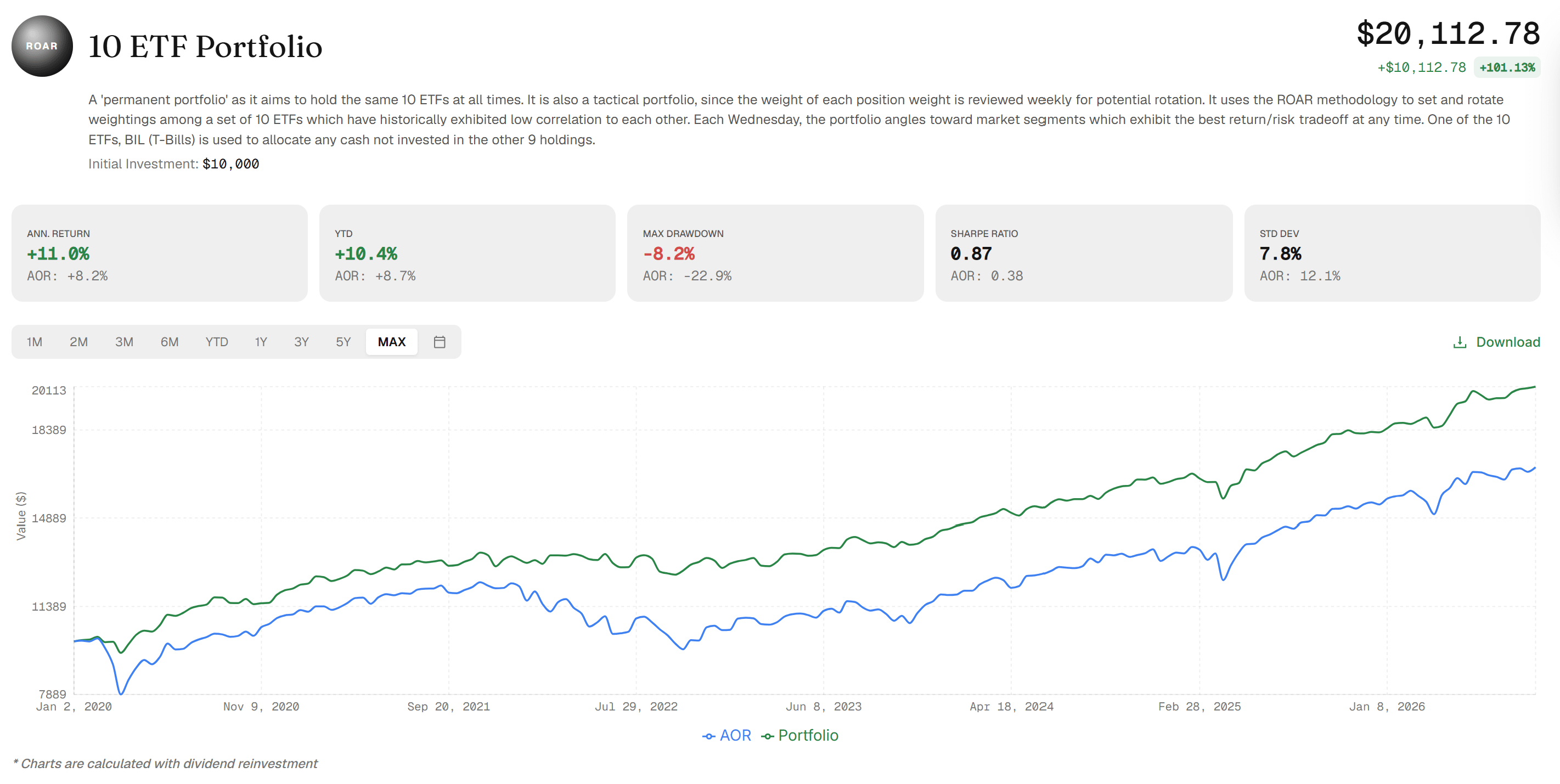
ROAR 10 has fulfilled my mission to provide a true 60/40 alternative for investors during its first 6+ years. That’s why it serves as a base for ROAR Flex, where I start with ROAR 10 as a “core” and expand the “toolbox” to navigate any market conditions that might arise.
Let’s quickly review ROAR 10 head-to-head versus AOR, an ETF that is iShares 60/40 portfolio in a single ticker. Very convenient. But the data below makes me think there’s a better way.
First, there’s the sustained outperformance of ROAR 10 vs. AOR. Much of that was achieved when it really counted, in early 2020. The S&P 500 fell 34% in 5 weeks, and AOR dropped by more than 20%. ROAR 10? It barely budged.
Know what you own. Know why you own it. And invest with intention, not just because it is currently popular.
For questions or more information, email us at info@sungardeninvestment.com, or visit our research site for DIY investors, ROAR.PiTrade.com.
And for more analytics comparing ROAR 10 to 60/40 and to the S&P 500, visit this new post in our ROAR Flex tab.
Now, here’s a few market highlights to start this abbreviated week.