


“Look both ways before you cross the street.” We are told that as kids. That expression is also vital in the investing world. Yet so few actually do it.
We are all taught to buy securities. And perhaps some are taught a form of sell discipline. But are they taught how to make money, or at least avoid steep, potentially life-altering declines in portfolio value? NO. At least, not enough for my satisfaction.
That’s why ETFYourself.com exists. Because it is NOT a one-way street.
At least not around here it isn’t. My goal as an investor, really since I started managing other people’s money in 1993, has been, above all else, allow them to fight for another day. That is, to take major risk of loss off the table, by any means necessary. The older I get, the more that makes sense to me as an investor myself. And the more I see markets toy with our hard-earned capital as they regularly do, the more I’m glad I took that path.
There’s just way too much careless, flippant chatter on Wall Street. “Time in the market, buy and hold, bear markets are healthy.” It sounds like a Marlboro cigarette ad from the 1950s! So, let’s skip that trip to “flavor country” and focus on my favorite flavor of investing: the all-weather kind.
Why learn to play offense AND defense at the same time?
Because your 10-years-older self will thank you. And your next generation too. That’s why.
Hey, I get it. The stock market usually goes up. But that’s like saying people my age (61) usually live until age 80. Here’s the S&P 500, 10-year rolling returns, as of each 10-year period from 2000 through now. I drew a fat yellow line across the 8% annualized return. What do you see?
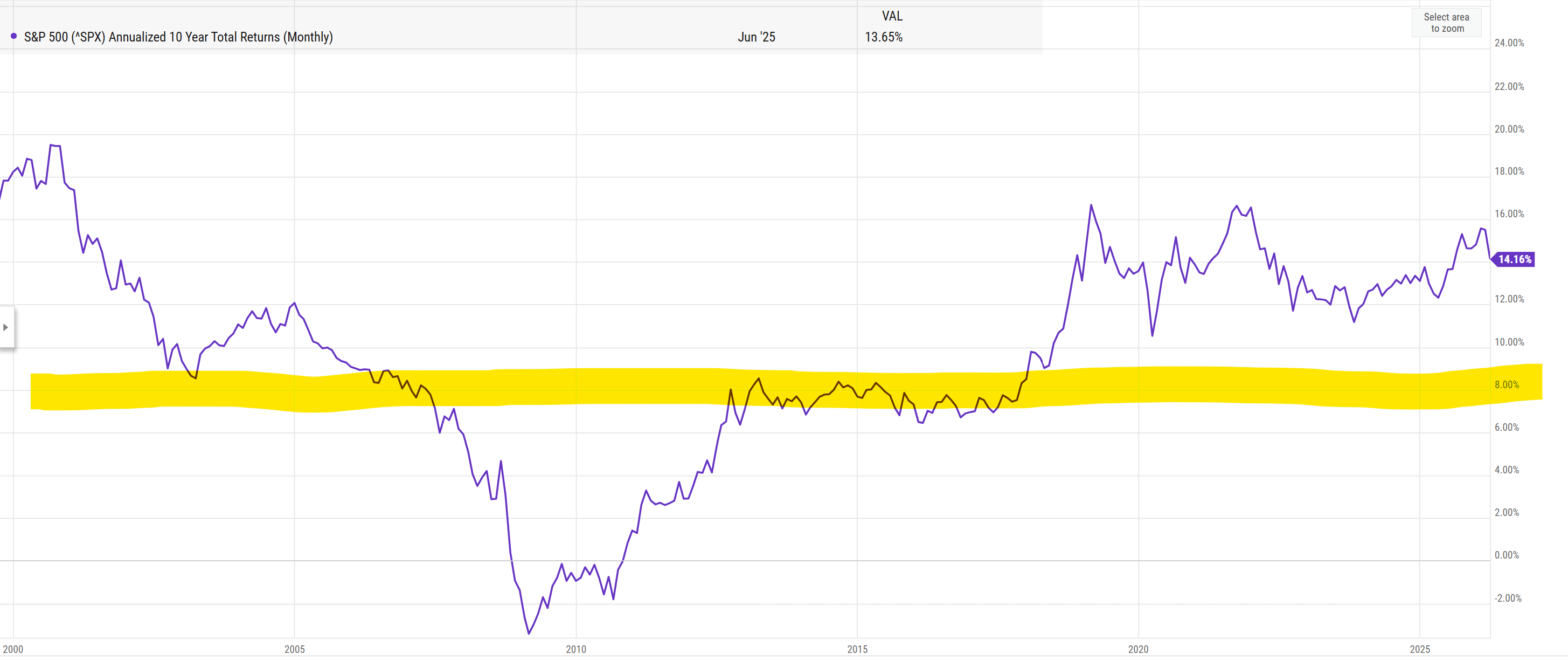
I see that as pretty close to a MEDIAN. What’s that mean? That returns well south of 8% a year are not only to be expected over time, they are quite frequent. And since they tend to occur in cycles, with the tide being as high as the far right side of that chat shows, and having been high for the past 7 years, why not learn to defend, not just attack? As it turns out, sometimes the best defense can be a good offense.
And, if there’s one time you do not want to be “average” as an investor, it is during a period where the financial markets do not serve as a wind at our back. While I think the wind is shifting against investors, it is not about guessing. It is about a simple question: do you want to invest in a way that is prepared for ANYTHING, or just for when the weather is beautiful? If you read my work regularly, you’re likely in the latter camp.
Yet there’s so little education available about this topic, this risk management I speak of constantly, and show to subscribers multiple times a week here. And what’s worse, a lot of what passes for “defense” is put forth more for immediate gratification, rather than an actual, strategic approach to managing risk. Because while this or that market segment can be a light of hope for a little while, that often leads to a false sense of security.
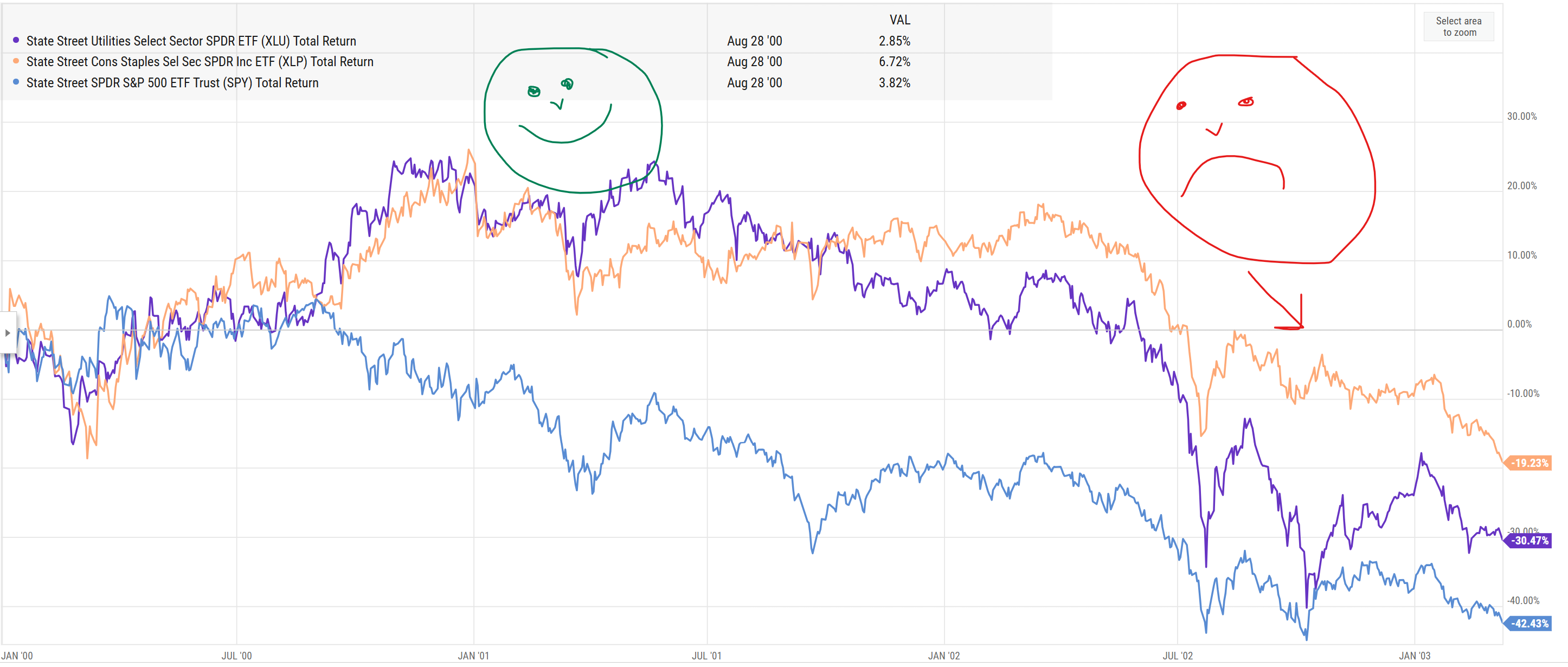
I wanted to make this point to you so badly, I was willing to resort to drawing happy and sad faces on a serious chart. When I hear the typical cheerleading such as “just own consumer staples and utilities, and you’ll be fine,” my mind goes RIGHT BACK to the 2000-2003 period. The dot-com bubble was bursting, and those 2 sectors did indeed serve as an oasis. That’s the green happy face period above.
But then, Mr. Red Face took over. By the time that 3-year plunge was over, no sectors were green. Oh, they outperformed SPY over that time. By losing less. Last I checked, I can’t feed my family on “relative returns to the market.”
Managing risk is about more than a transaction. It is about making it a full-fledged member of the team that is my portfolio.
Now, let’s look at the current, rapidly-changing market landscape as we do every Tuesday here, and I’ll show you and tell you what I’m seeing right now. Without the use of happy and sad faces. Which should make everyone happy.
Let’s start with this, what I think is the silent market driver most are not considering.