


Braylon Mullins might be the most divisive figure in the United States right now. And he’s not even a politician!
He’s the 6-foot-6 freshman from the University of Connecticut, whose 3-point shot shocked the sports world last Sunday during the NCAA March Madness tournament. He sent UConn to the Final Four, and sent Duke fans, along with many frustrated bracket-holders, to the showers.
I have nothing at stake in that dogfight. My bracket was busted when Michigan State lost. But the more I thought about what could be one of most memorable moments in college basketball history, it did what sports often does: it made me analogize to investing.
So, at a time when markets are reeling, “buy the dip” chatter is everywhere, “sell the rip” is what’s working, and the value of our accumulated wealth seems to be way too dependent on social posts and suppositions, I’m taking a time out.
I’m doing so to point out a few of my “go-to” investing tenets that are playing out right in front of our eyes. Because in a quarter (Q1 2026) where the main strategy I make available and discuss with subscribers here (ROAR 10 ETF) is battling today to get to a 3% gain for the quarter while the S&P 500 tries to rally to end the period around -7%, there are important observations to make.
This is NOT about how I beat the market by 10% in a quarter. It is one quarter. I can practically assure you that if SPY rallies 10% the next quarter or even month, ROAR 10 ETF will not match that.
However, it IS about how any investor, either following my lead or on their own, can learn to be competitive in down markets. And ultimately, about what every investor really wants for themself.
It has ZERO to do with day trading or what stocks you own. It has EVERYTHING to do with creating and carefully executing an investment process built to “play offense and defense at the same time.” It means investing methodically, not guessing and speculating.
In that instant classic UConn-Duke NCAA basketball game, the attention has been focused primarily on Mullins’ shot, which came with 0.3 sections left on the clock. However, there’s far less written about Silas Demary Jr. He’s the UConn player that tipped the Duke pass in the final second, which allowed UConn to get possession of the ball. No ball, no heroic, game-winning shot.
Defense wins championships. Or in this case, gets you to the Final Four.
Investing in a way that prioritizes defense, instead of just “how much can I make when the market goes up,” isn’t as fun and exciting as “what I’m buying here” and “my picks for the Iran War relief rally.” Fortunately, there is no shortage of outlets for those who see stock and other markets as something other than what they are to me: simply a tool to get what we want out of life, by having enough money to do it comfortably. Immediate thrill or eventual comfort. That’s the caveman-like decision everyone makes.
By the way, how many year-end stock picks are working out so far? A quick scan of the 20 biggest S&P 500 stocks shows that 3/4 of them are down. My point: stock picks are mostly meaningless in a market that now runs on passive flows in and out of index funds, algorithmic trading, and dare I say, a level of insider trading the likes of which I have not seen in 40 years of doing this.
How to Bend, But Not Break
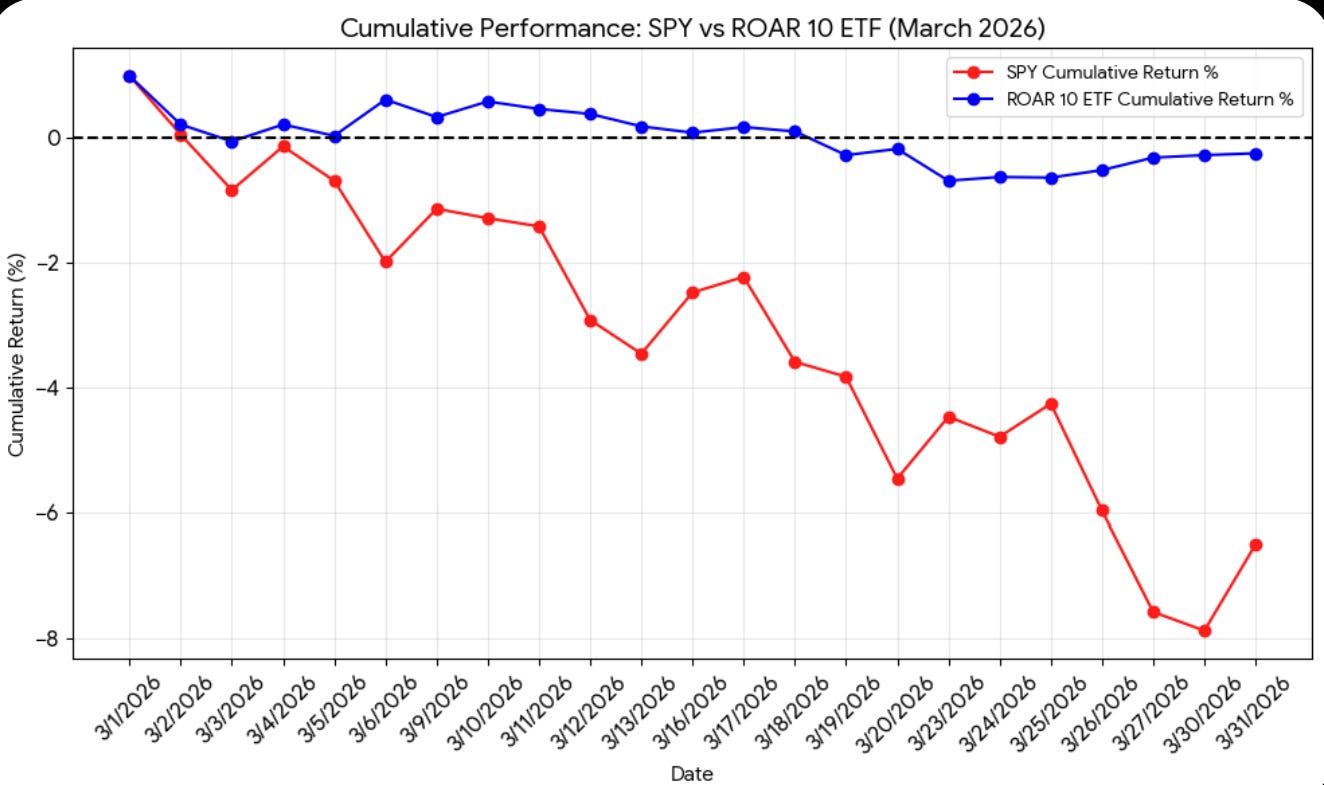
In that “eventual comfort” camp, we emphasize things like “low standard deviation.” Translated to English, that means your portfolio’s value fluctuates in a tighter range over time. I’ll use ROAR 10 ETF’s actual path during the month of March, versus the SPY ETF, to make that point as clear as I can. About what my investing style is, and isn’t.
Here, right from the ROAR.PiTrade.com site, is the first quarter. ROAR 10 ETF in blue, and its “best-fit” benchmark, ETF ticker AOM, which is 40% stocks/60% bonds. Again, SPY was down 7% through yesterday. QQQ was off closer to 10%. The AGG bond index ETF was off slightly.
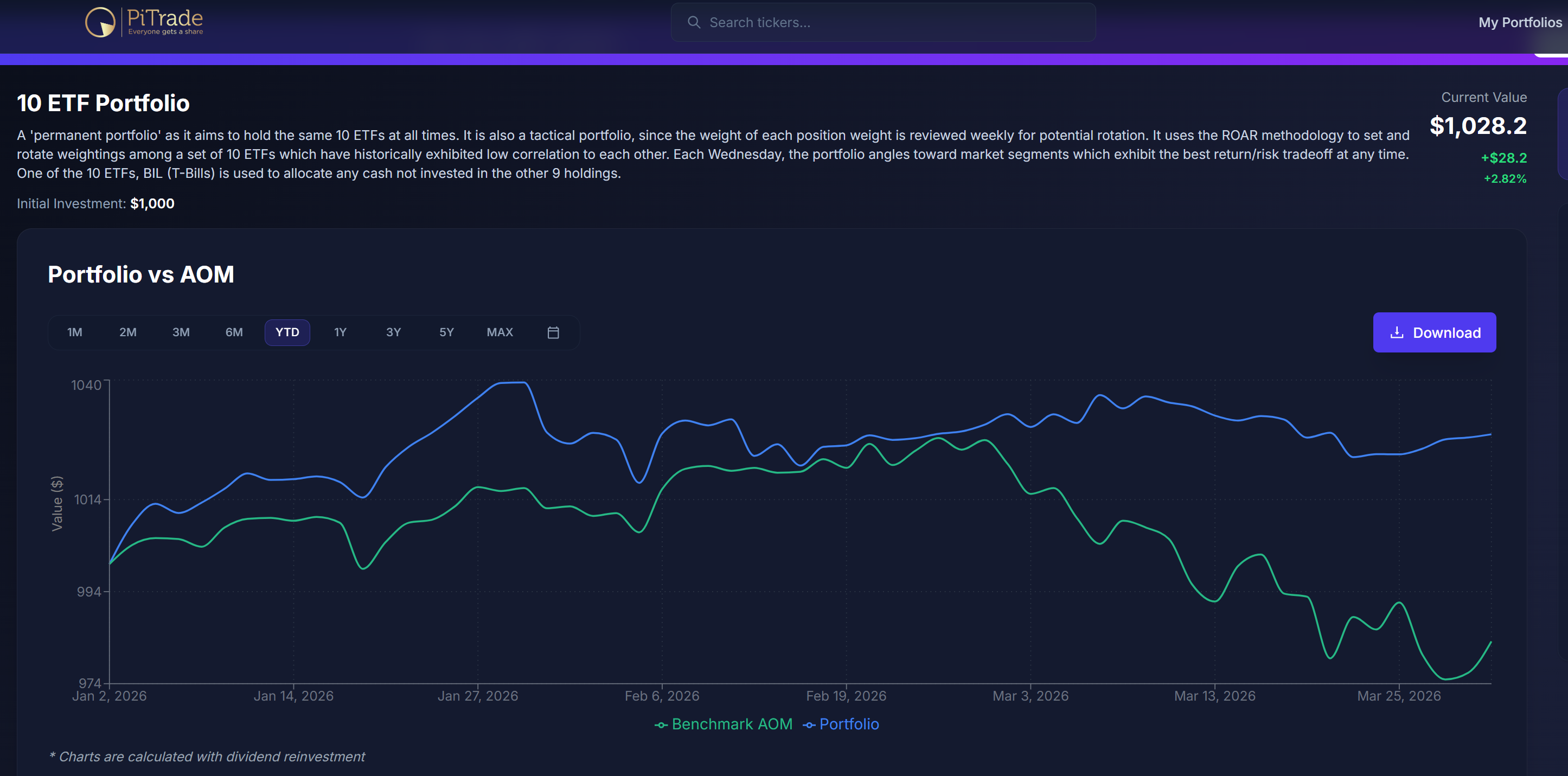
The month of March is where things went from bad to worse, thus earning the moniker “March Badness” from me. ROAR 10 ETF hung in there.
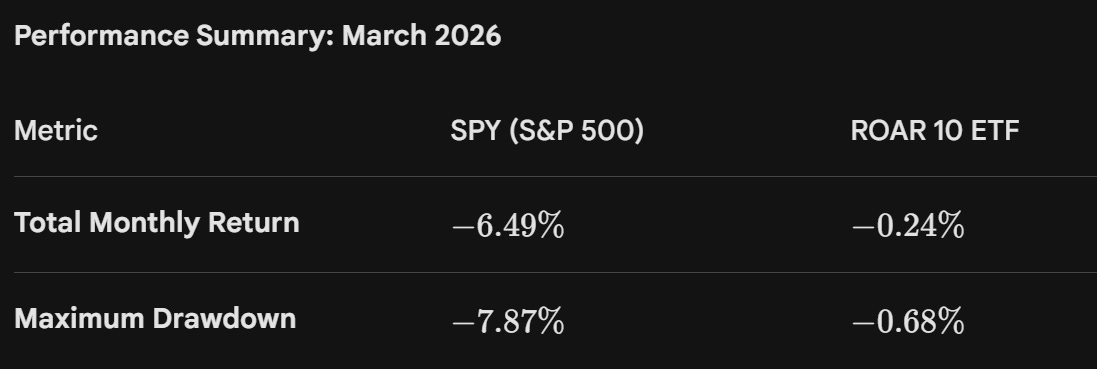
Those are the “headlines” and as I always tell you, there’s a lot underneath. So to finish this review of my risk-managed investing process, through the eyes of the worst market quarter in years, here are a few bullet points to round out what I call the "bend, don’t break” philosophy through three key behaviors:
Resilience on “Red” Days: There were 6 days during the month where the S&P 500 dropped by more than 1%. In every single one of those instances, ROAR 10 ETF significantly outperformed the market. On 4 of those 6 high-volatility days, ROAR 10 actually posted positive returns while the market was falling.
Mitigating the “Deepest Cuts”: While SPY investors watched their cumulative monthly return sink to a low of 7.8% by March 30th, the ROAR 10 ETF never saw its cumulative performance dip below 0.7%. This limited “bend” prevented the emotional panic that often leads investors to sell at the bottom.
Superior Risk-Adjusted Stability: The volatility of the ROAR 10 ETF was roughly 4 times lower than that of the S&P 500. This smoothed the investment journey, allowing for a “calm and confident” perspective.
Next up? Who knows. But the process is prepared for it.
This has everything to do with proactive construction of the portfolio, and a time-tested allocation methodology. I use my creation, the ROAR Score, and a central part of our paid subscription services is my teaching people how to use it. My own “best practices” if you will.
But I do not have a monopoly on solid investment process. So my work is here to be used however any individual investor chooses, to, as they chart their own course. Literally.
Now, I’ll take a look at ETFs, stocks and the broader market climate. Not to predict the future, which is fun but ultimately pointless. To assess market risk and invest in a way that balances that with the return potential that always exists.