Here’s a tab-by-tab guide to what you see on our site, and how to start working with it. Don’t feel like you have to master it all. These are principles and features of ETF Yourself I’ll keep coming back to, over and over again.
Here, we walk you through the key steps to start thinking like a portfolio manager. Our long-time subscribers have helped us get this far in breaking down some powerful concepts and helping me to translate them from my portfolio manager’s brain to a format that a wider audience of serious investors can adapt as they see fit. We look forward to you being part of that continuous brainstorming process as you get comfortable with how this all works.
And if you are in the Premium version of our service that includes our weekly live session, we’ll interact live, and you can ask me questions as you learn the process I’ve used for decades, managing money professionally.
HOME
As with many other publications on the popular Substack platform, ETF Yourself’s home page is a starting point, containing some of our latest public posts, and some timeless content we think subscribers will want to keep front-of-mind.
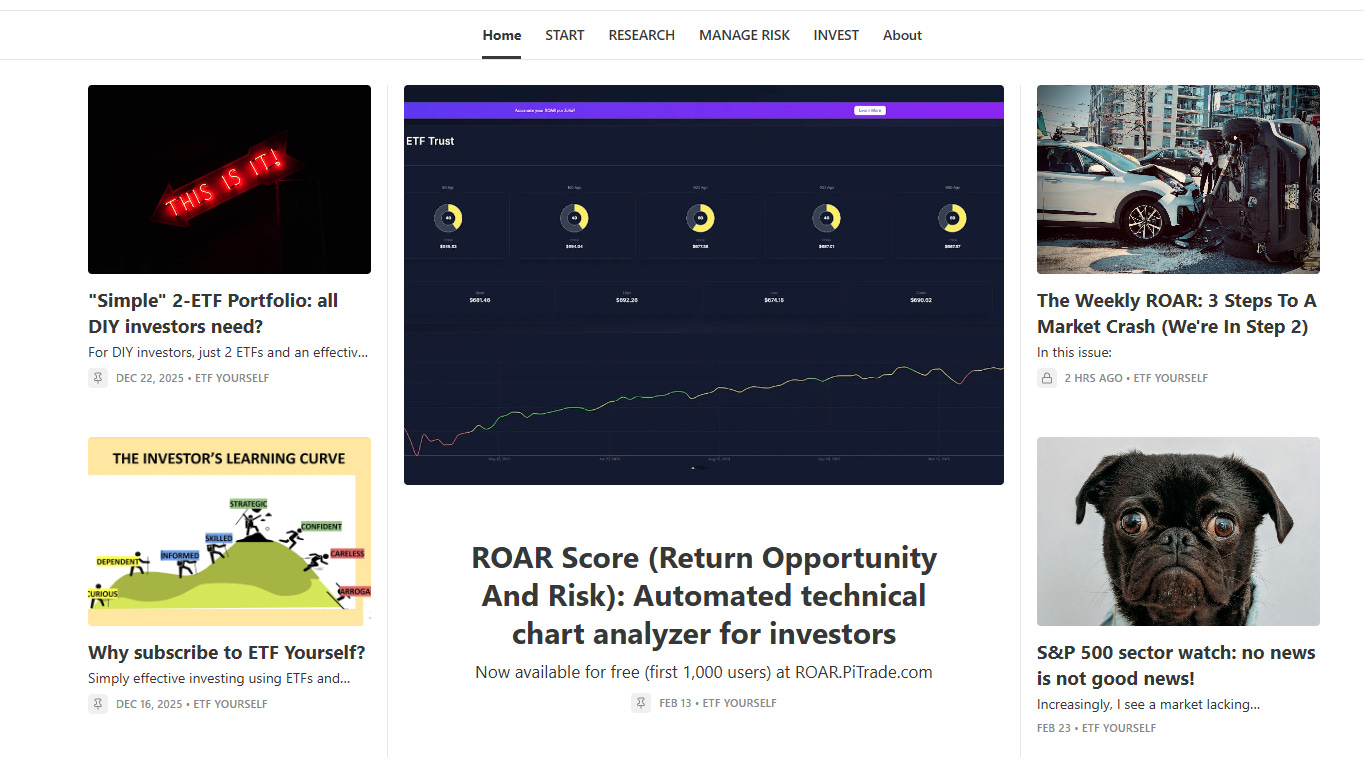
Now, let’s take a look at what’s in each of the main tabs.
START
Learn Investing Basics…accurately. That last word is so important.
Our observation about today’s instant-gratification, popularity-driven, adversarial online culture? We’ve never had more information at our fingertips, and we’ve never used less of it! We try to approach it differently.
That means clarifying and correcting some common misinterpretations of traditional investment education. Some of what DIY investors learn is just fine. But too much of it is neutered by sound bites, oversimplification, and greed of the communicator. Not here. Ever.
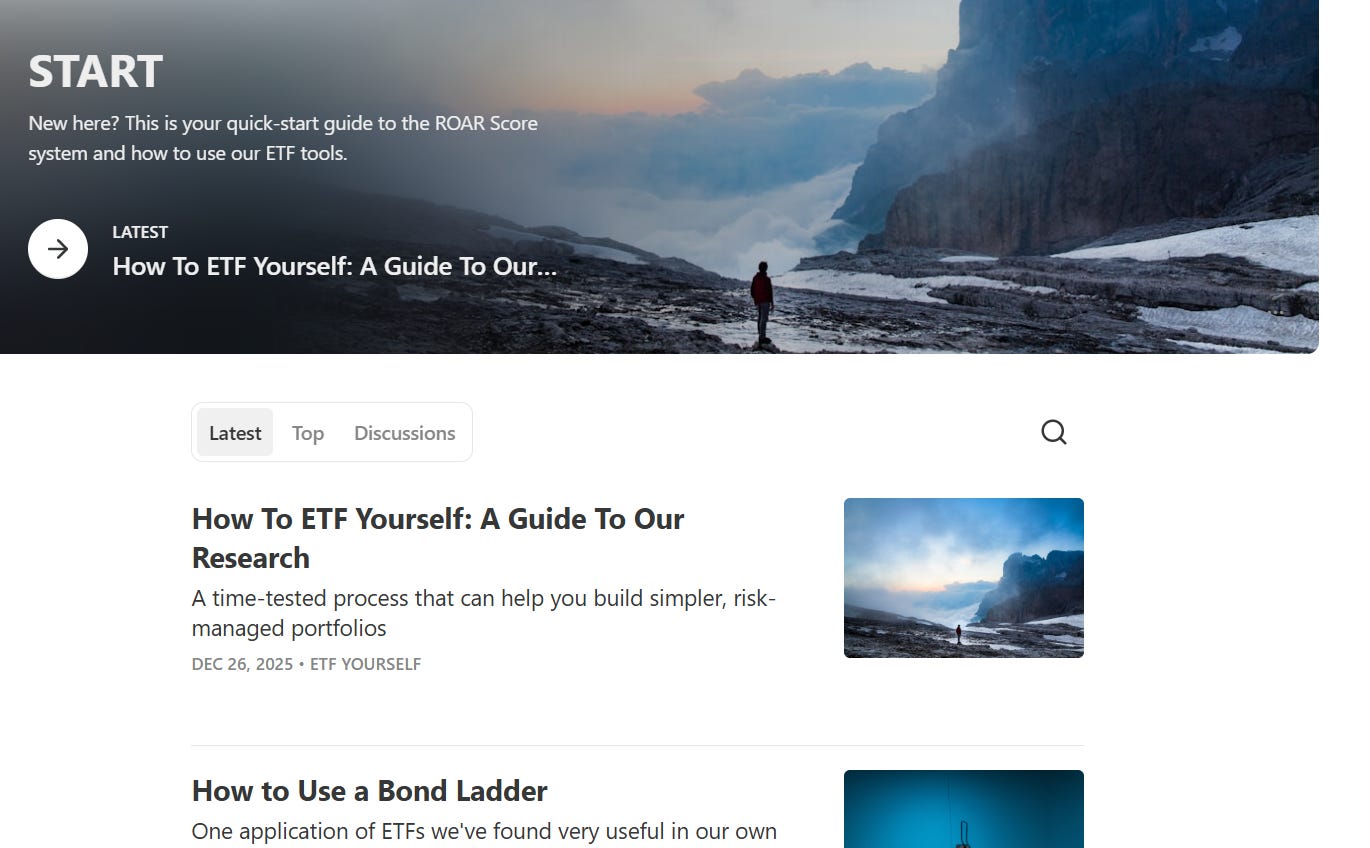
This serves as our introduction, providing the foundational philosophy and tools needed to use the ROAR Score system effectively. It is designed to help DIY investors transition from speculative “price-chasing” to a professional, risk-managed process.
The page highlights several key pillars of the ETF Yourself approach:
1. The Core Philosophy
How To ETF Yourself: This lead article outlines a time-tested process for building simpler, risk-managed portfolios. It emphasizes that the goal isn’t just to find “winners,” but to manage the “climate” of the market.
Rob’s Rules of Risk Management: A collection of 30 key takeaways from Rob Isbitts’ 30+ years of professional investing experience, serving as the “moral compass” for the site’s strategies.
2. Proprietary Tools
The ROAR Score: This section introduces the proprietary risk-management tool that assigns a “grade” to the market. It explains how to interpret these scores to adjust your exposure between growth assets and capital preservation.
DIY GPS: A guide to navigating the “fog of hype” in the financial media by sticking to a disciplined, data-driven framework.
3. Practical Portfolio Building
The START page provides specific “blueprints” for different investor needs:
The “Simple” 2-ETF Portfolio: Demonstrates how just two ETFs and an effective allocation system can cover significant ground for most investors.
Bond Ladder Strategies: Includes deep dives on how to use ETFs as a “Treasuries Plus” bond ladder, combining long-term predictability with short-term opportunity.
.
RESEARCH
This serves as the analytical hub for DIY investors, focusing on risk management and market climate assessment through three primary pillars:
1. The Weekly ROAR
Each week, the format is as follows:
In the issue. A quick introduction. This is available to non-paying subscribers as well, absent the key details reserved for paid subscribers.
Robservations, Rob’s blunt assessment of the current market climate, and potential drivers of portfolio results. This covers multiple time frames, from what’s happening right now, to a few months out, and even a few years out
Charts I’m watching. A set of charts covering ETFs, indexes, economic indicators, and some stocks too. This is where Rob bottom-lines how his chart work informs his views on risk management and where he thinks money will be treated best.
ROAR Score weekly update. A quick statement about the current level of our primary risk indicator, and how it maps to the allocation of our simple 2-ETF portfolios. Note that while ROAR is an overall risk indicator for investors to consider, its application here is specific to determining the allocation between stocks and cash, via an allocation to the ETF tickers SPY and BIL. So factors such as T-bill interest rates, analysis of the S&P 500 versus other indexes, and Rob’s general bent toward conservative investing have a heavy impact here.
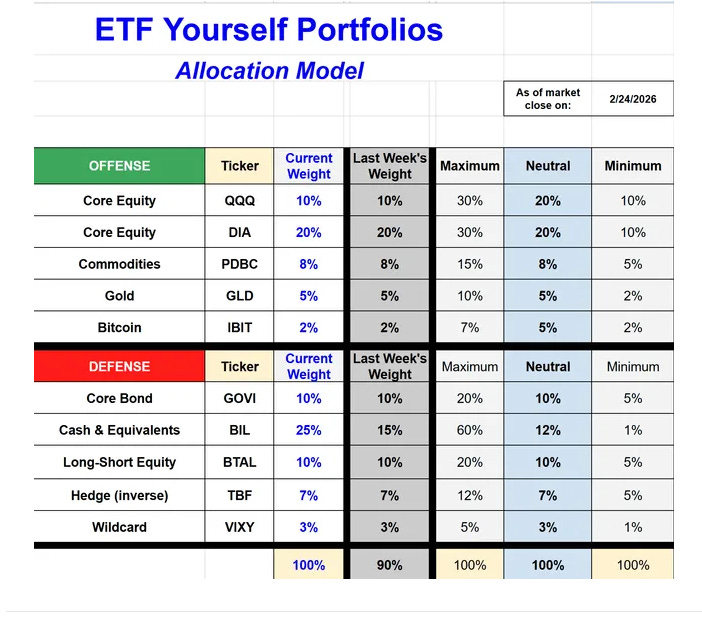
Allocation Model: weekly update. The 2-ETF portfolio concept is perhaps the fastest-growing aspect of ETF Yourself. Rob is constantly researching other combinations of ETFs that work well together as “offense/defense” pairs. But for those who like the idea of a more diverse set of ETFs in a portfolio, the Allocation Model will be a useful tool.
Each week, we display the current model, which is comprised of 10 different ETFs (5 offense, 5 defense). We gravitated toward a “permanent portfolio” concept here, in that the model allocates to all 10 ETFs, all the time. We show the current weight/allocation to each, and also compare it to our “neutral” weights. That’s our assumption of the long-term average weight we’d expect to assign to each one.
2. Daily Observations (The “Daily ROAR” Context)
While the Weekly reports provide the macro view, the research section includes frequent, daily updates and deep dives that track immediate market shifts. These include:
S&P 500 Sector Watch: Real-time analysis of leadership (or lack thereof) within market sectors.
Technical Spotlights: Specific “Charts of the Day,” such as the “Circus Tent” chart for silver or technical breakdowns of individual stocks like Blue Owl.
Tactical Nuance: Observations on whether the S&P 500 is at risk of declining faster or finding support.
3. The Sunday Edition (Weekly Digest)
The Sunday Edition acts as a comprehensive “Weekly Investing Digest.” It summarizes all the writing, myth-busting, and educational content produced by Rob Isbitts over the previous seven days. It is designed to ensure subscribers stay caught up on:
Market trends and ETF performance.
Educational pieces for DIY investors.
A consolidated view of the week’s research across multiple media formats.
MANAGE Risk
Managing risk is THE priority for us. Steep losses simply take too long to recover from. So why not do all we can to avoid them? Does that mean performance suffers? Not in our experience. It just means it is less exciting. To us, that’s not a bad thing.
ETFs are the central investment vehicle we use here. However, Rob’s diverse work in managing risk spans well beyond that. So this section of this site is our ongoing focus on how to manage risk, with ETFs and beyond.
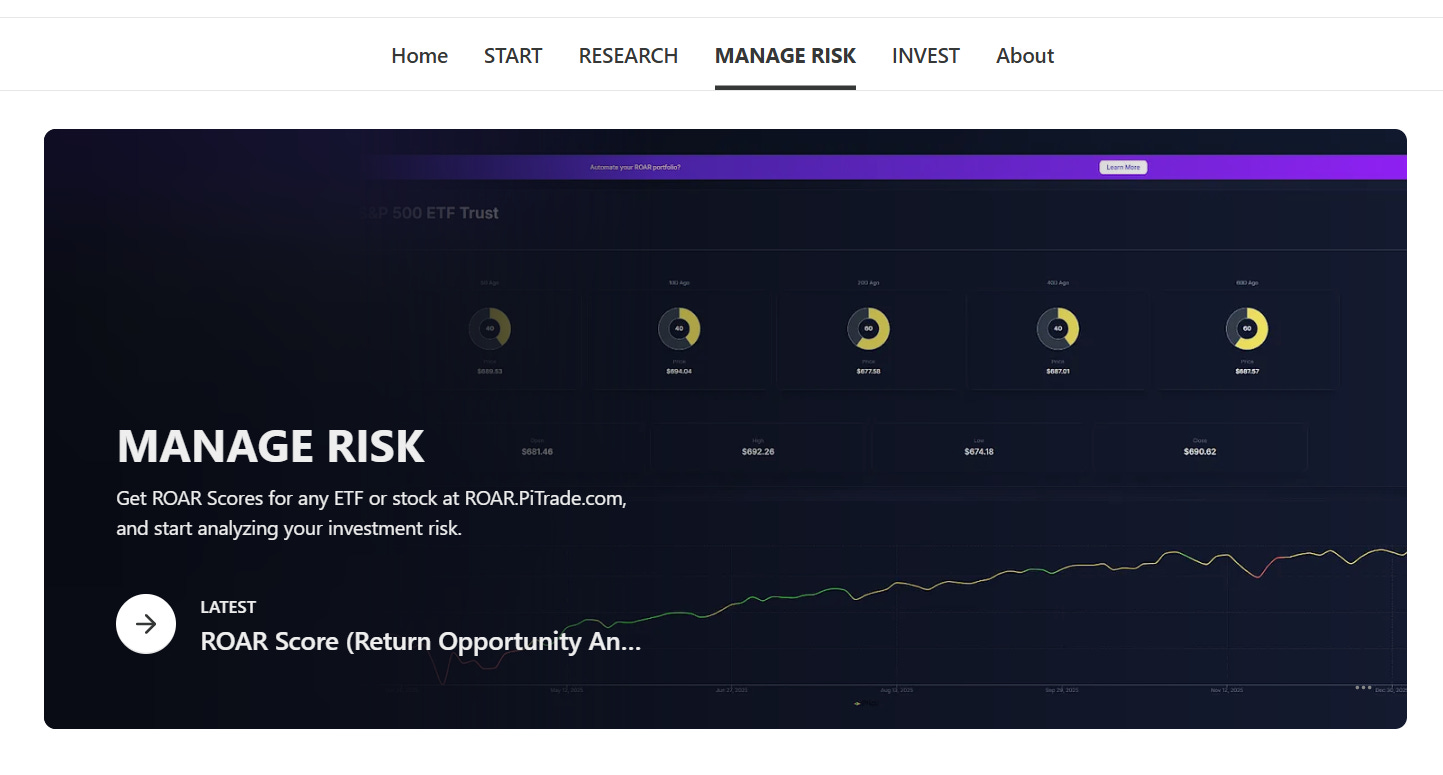
At ETF Yourself, we rely heavily on our proprietary ROAR Score which can be applied to any ETF or Stock, using the system at Roar.PiTrade.com
.
INVEST
The INVEST section focuses on the practical application of the research and risk-grading found elsewhere on the site. It acts as the “execution” layer for the ETF Yourself philosophy.
The section is defined by two primary paths for subscribers:
Model Portfolio Implementation: The flagship strategy highlighted is the 10-ETF Allocation Portfolio. This is described as a powerful, differentiated way to grow capital using proactive risk management combined with the analytics of the ROAR Score.
Execution Options: Subscribers can choose their level of involvement:
DIY: Create and manage your own portfolios based on the provided research.
Copy-Trading: For those who prefer a more automated approach, the section points to PiTrade.com (as noted in the section header) where users can directly copy-trade Rob’s models.
Performance Transparency: This area includes the Investment Performance Update, which tracks both live and hypothetical returns for the model portfolios (last updated as of late 2025).
ABOUT
This last section aims to help you understand where we’ve been in the business of helping investors in many formats. That includes Rob’s 27 years as a fiduciary investment advisor, 3 stints as a mutual fund manager, and now, since 2020, as a researcher and publisher, delivering exclusively non-personalized investment content.